

A social media system, defined
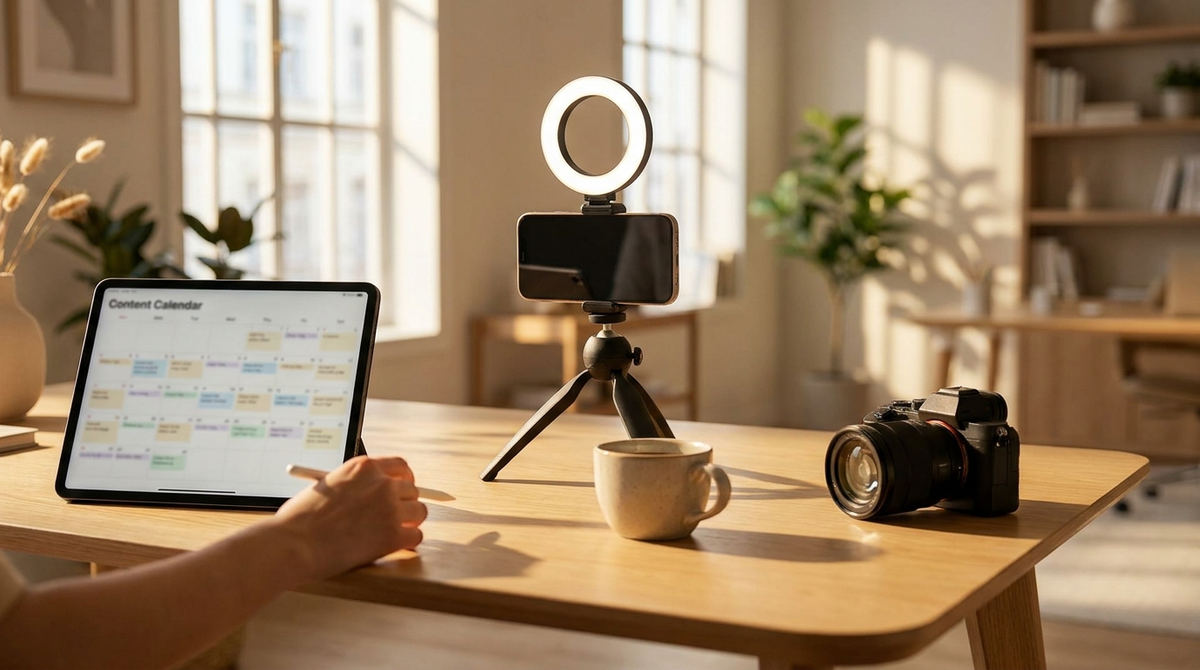
A social media system is the repeatable machine that turns a small business owner's expertise into a steady stream of posts without the owner being the one who films, edits, captions, and schedules every piece. Instead of posting when you remember to, the system handles capture, production, scheduling, and review on a fixed cadence. You feed it raw material once or twice a month. It produces weeks of content. The difference between a system and "trying to post more" is that a system keeps running on the weeks you are slammed, traveling, or closing a deal, which is exactly when most founders go dark.
Why do most small business owners stall on social media?

Not because they lack ideas. Because posting is the easiest thing to drop. When you are the salesperson, the operator, and the person who answers the phone, a Tuesday post loses every time to a customer who needs you now. The account goes quiet for three weeks, the algorithm forgets you, and the few posts you do manage feel like they go nowhere. That cycle reads as "social doesn't work for my business." It is not that. It is that posting was never built as a system, so it stayed a willpower problem. Willpower loses to a full calendar every time.
What are the parts of a content engine that actually compounds?

A system that runs without the owner has five moving parts. Each has a single owner and a deadline.
- Capture ritual. One scheduled session, every two to four weeks, where raw material gets recorded in bulk: a filming block, a voice-note brain dump, a screen recording of work in progress. The founder shows up for this and nothing else.
- Content bank. A single place where every idea, clip, photo, testimonial, and before/after lives. The bank means production never starts from zero.
- Production line. Editing, captions, hooks, thumbnails, all handled by someone who is not the founder. Raw clips in, finished posts out.
- Scheduled calendar. Posts loaded and queued ahead of time, so the feed publishes on schedule whether or not anyone touches it that day.
- Weekly review. A fifteen-minute look at what landed, what to make more of, and what to cut. This is the assurance step, the part that keeps the engine pointed at results instead of just running.
Miss any one part and the system leaks. No capture ritual and the bank runs dry. No review and you keep making content nobody engages with.
How often does a small business actually need to post?
Less than the internet tells you, and more consistently than you are doing now. Three to five quality posts a week, held steady for months, beats ten posts one week and silence the next. The system exists to protect that steadiness. Cadence without consistency is noise. Consistency is what lets content compound.
Doing it yourself vs a freelancer vs a content system
- Founder posts when they can — What breaks: Drops the second work gets busy · Consistency: Low · Owner's time: High, in scattered bursts
- One freelancer or editor — What breaks: No capture ritual or review, so they run out of raw material and guess · Consistency: Medium · Owner's time: Medium, lots of back-and-forth
- A content system (capture + bank + production + calendar + review) — What breaks: Designed not to break when the owner is unavailable · Consistency: High · Owner's time: Low, one filming block plus a weekly review
What does compounding content look like in practice?
Mo.Details, a Houston autocare shop, is the clearest example. The win people remember is a single reel that crossed 850,000 views. The part that matters is what produced it: a consistent content engine running week after week, so the shop was always putting out enough at-bats for one to break out. You cannot schedule a viral moment. You can build the system that makes one likely, then again likely the next quarter. That is the whole point of compounding. The audience, the back catalog, and the algorithm's trust all stack on top of each other instead of resetting every time the founder gets busy.
The same logic applies whether you run a med spa in Sugar Land, a trades business in Katy, or a studio in The Woodlands. The product changes. The need for an engine that runs without you does not.
The move
If your account goes quiet every time work gets busy, the problem is not effort, it is that posting was never built as a system. That is the layer we install: capture, bank, production, calendar, and a weekly review that keeps it honest, so your feed runs whether or not you have a free Tuesday. If you want to stop being the bottleneck on your own marketing, tell us what you are working with and we will map the engine to your business.
---
Questions we get on this topic.
How much time do I have to put in if I hand off my social media?
With a real system, one filming or capture block every two to four weeks, plus about fifteen minutes a week to review what is working. Everything between, editing, captions, scheduling, is off your plate.
Do I need to be on camera for this to work?
It helps in some industries, but no. A content bank can run on product footage, customer results, before/after work, screen recordings, and team clips. The system is built around what you are actually willing to do consistently.
How long before a social media system shows results?
Reach and engagement usually move within the first 30 to 60 days of consistent output. Compounding effects, the back catalog and audience trust that make breakout posts likely, build over months. Anyone promising a viral hit in week one is selling luck.
Can I just hire one person to post for me instead?
You can, and many founders do. It usually stalls because one editor with no capture ritual and no review step runs out of raw material and starts guessing. The system, not the seat, is what keeps it consistent.
Keep going.

Stop Being the QA Department: Signs Your Business Runs You
If you are a founder doing everything, here are the signs your business runs you, and how to stop being the QA department your team cannot ship without.
Read →
The Houston Founder's Guide to Local Marketing in 2026
A Houston marketing guide for small business owners: the channels, budgets, and local SEO moves that actually pull Greater Houston customers in 2026.
Read →
Retention is the new growth area (and nobody's ready)
Acquisition costs are up 34% YoY across the categories we track. Retention isn't a nice-to-have anymore, it's where $1M–$10M founders win or die.
Read →